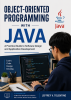
OBJECT-ORIENTED PROGRAMMING WITH JAVA: A Practical Guide to Software Design and Application Development
Keywords:
Object-oriented programming, Java programming, software development, classes and objects, encapsulation, inheritance, polymorphism, abstract classes, interfaces, exception handling, application development, programming educationSynopsis
Object-Oriented Programming with Java: A Practical Guide to Software Design and Application Development provides a structured, practical, and learner-centered introduction to Java programming and object-oriented software development. Organized into fourteen chapters across five major parts, the book guides learners from Java foundations, data types, input and output, decision structures, loops, and arrays to classes, objects, methods, constructors, packages, encapsulation, inheritance, polymorphism, abstract classes, interfaces, exception handling, and complete application development. Rather than treating object-oriented programming as a collection of isolated language features, it develops object-oriented thinking as a disciplined approach to modeling real-world problems by combining data and behavior within clearly designed objects. Each chapter includes learning outcomes, key concepts, verified code examples, Philippine-context applications, best practices, common programming pitfalls, reflection activities, and self-assessments. Its central instructional feature is the cumulative Application Build, through which students progressively design, code, test, and improve a functional Java application while applying the concepts introduced in every chapter. The book is intended for computer science and information technology students, instructors, beginning programmers, and aspiring software developers seeking to strengthen their logical reasoning, coding discipline, problem-solving ability, and readiness for professional application development.
References
The full list of references can be found in the complete book.
Downloads
Published
License

This work is licensed under a Creative Commons Attribution-NonCommercial-NoDerivatives 4.0 International License.